
Best AI Art Tools in 2026 (and Why Human Art Still Matters)
Best AI Art Tools in 2026 | Complete Guide + Why Human Art Still Wins – Art League India.
A complete 2026 guide to the best AI art generators — Midjourney, Nano Banana, DALL-E, Ideogram, and more — compared, plus why hand-made human art is more valued than ever.
Index
- The State of AI Art in 2026.
- Best AI Art Tools Compared.
- Tool-by-Tool Breakdown.
- Why Human-Made Art Still Matters.
- Where AI Fits — and Where It Doesn't — for Artists.
- Final Verdict.
The State of AI Art in 2026
AI-generated art has moved from a novelty to a genuinely useful creative tool over the past two years. Image generators can now produce near-photorealistic scenes, consistent characters across multiple images, and accurate text inside graphics — tasks that were unreliable just a year ago.
At the same time, something interesting is happening on the other side of the art world. Galleries, collectors, and competition judges are increasingly drawn to work that is visibly human-made — imperfect brushstrokes, personal narrative, and the kind of emotional rawness that algorithms can't fake. Both trends are real, and they're not actually in conflict. Understanding when to reach for an AI tool and when to pick up a real brush is what separates artists who use AI well from those who let it flatten their voice.
This guide covers both sides: the best AI art tools worth knowing in 2026, and why traditional, human-made art is holding — and even gaining — its ground.
Register & Test Your artistic skill @ Art League India.
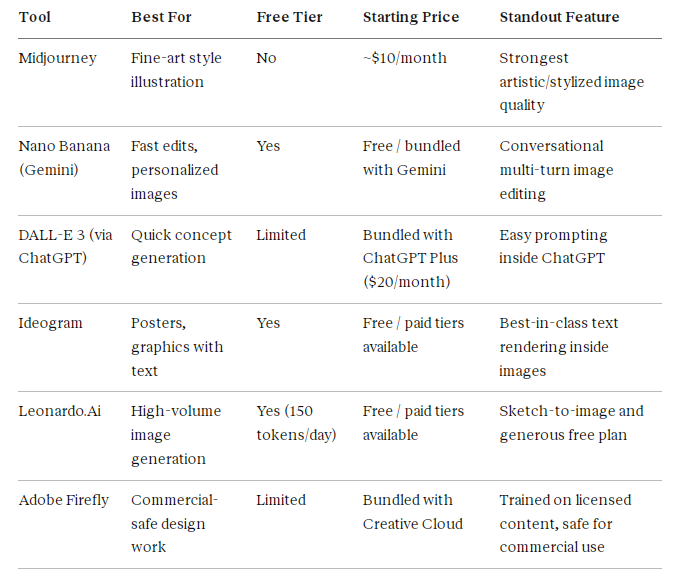
Best AI Art Tools Compared
Tool-by-Tool Breakdown
Midjourney
Widely regarded as the leader for artistic and stylized output, Midjourney remains the go-to choice among illustrators and concept artists who want painterly, atmospheric results rather than photorealism. It works through Discord or a web app and requires a paid subscription — there's no free tier.
Good for: mood boards, concept art, stylized illustration references.
Limitation: No free plan; a learning curve for prompt-writing.
Nano Banana (Gemini's Image Model)
Nano Banana is Google's native image generation and editing system inside Gemini. It stands out for conversational editing — you can keep refining an image across a back-and-forth chat, maintain character consistency across edits, and even generate accurate, legible text in multiple languages for things like posters or mockups. A more advanced version, Nano Banana Pro, adds higher resolution output and more precise creative control.
Good for: quick edits, restoring old photos, iterative design tweaks.
Limitation: Less suited to painterly, fine-art stylization than Midjourney.
DALL-E 3 (via ChatGPT)
Bundled directly into ChatGPT, DALL-E 3 is the easiest entry point for anyone who already uses ChatGPT for writing or research. It's fast and convenient for quick visual concepts, though it doesn't match Midjourney's artistic depth.
Good for: fast concept visuals, brainstorming, casual use.
Limitation: Output style is more generic/commercial than fine-art focused.
Ideogram
If you need an image with text that actually reads correctly — a poster, a certificate mockup, a social media graphic — Ideogram is the strongest option available. Most AI image generators still struggle with legible in-image text, and this is where Ideogram consistently outperforms competitors.
Good for: posters, event graphics, certificates, social media templates.
Limitation: Less focused on painterly/artistic image styles.
Leonardo.Ai
Leonardo.Ai offers one of the most generous free tiers in the AI image space — enough daily tokens for dozens of images — plus sketch-to-image controls that let you guide composition more precisely than a text prompt alone. Commercial use is allowed even on the free plan.
Good for: budget-conscious creators, sketch-based workflows.
Limitation: Images are public by default on the free tier.
Adobe Firefly
Built into Photoshop and the Adobe Creative Cloud suite, Firefly is trained specifically on licensed and public-domain content, which makes it a safer choice for commercial projects where copyright provenance matters.
Good for: designers already working in Adobe tools, commercial projects.
Limitation: Requires a Creative Cloud subscription for full access.
Register & Test Your artistic skill @ Art League India.
Why Human-made Art Still Matters
Here's the twist most "AI vs. art" articles miss: as AI-generated imagery has become more common, demand for visibly human-made art has grown alongside it, not shrunk. Art world analysts tracking 2026 trends point to a clear shift toward naïve, imperfect, and intuitive painting — work that carries loose lines, awkward proportions, and unmistakable evidence of a human hand behind it. Collectors and audiences are responding to that honesty specifically because AI-generated imagery has become so common and so polished.
This isn't nostalgia — it's a recalibration. After a period defined by algorithmic perfection, people are actively seeking out the opposite: art that feels intuitive, risk-taking, and personal.
What this means practically for artists:
- Judged competitions increasingly reward originality and process, not polish. A hand-drawn piece with a genuine point of view often stands out more than a technically flawless but generic image.
- Texture and material presence are back. Mixed media, visible brushwork, and dimensional surfaces are trending specifically because they can't be replicated by a prompt.
- Storytelling beats perfection. Judges and collectors alike are drawn to work with a real narrative — a memory, a cultural reference, a personal struggle — something AI has no lived experience to draw from.
- Buyers want a "real maker" behind the work. Direct-to-collector art sales are rising, and buyers increasingly want to know the story and the hands behind a piece, not just the image.
Where AI Fits - and Where It Doesn't - for Artists
AI tools and traditional art skills aren't actually competing for the same purpose. Used well, AI can support an artist's process without replacing their voice:
Where AI genuinely helps:
- Generating quick mood boards or references before starting an original piece.
- Creating social media graphics, event posters, and promotional material.
- Speeding up non-creative tasks like certificate design or marketing copy visuals.
Where human skill still wins — and always will:
- Competition and gallery submissions where originality and process are judged.
- Building a personal artistic style collectors recognize and follow.
- Emotional, narrative-driven work that draws on lived experience.
- Physical mediums — painting, sketching, mixed media — where texture and material presence can't be faked.
Register & Test Your artistic skill @ Art League India.
Final Verdict
AI art tools are genuinely useful — for reference gathering, marketing visuals, and fast concept work. But if you're building a career or portfolio as an artist, especially one aimed at competitions, galleries, or direct collector sales, your hand-made, original work is more valuable now than it's been in years. The market has actually shifted in favor of visible human effort precisely because AI-generated imagery has become so widespread.
Use AI as a tool in your creative toolkit — not as a replacement for the thing that makes your art yours.
Put Your Human-Made Art to the Test
Art League India's online competitions are judged on creativity, originality, and technique — exactly the qualities that set human-made art apart. Whether you paint, sketch, or work in mixed media, this is your chance to be seen and recognized for the work only you could make.
*** Explore our current competition at www.artleagueind.in.
Frequently Asked Questions:
- Is AI art allowed in art competitions?
Most reputable competitions, including those at Art League India, require original, human-made artwork and prohibit AI-generated submissions to keep judging fair.
- Which AI art tool is best for beginners?
Nano Banana (inside Gemini) and Leonardo.Ai are the easiest to start with, thanks to free tiers and conversational, prompt-friendly interfaces.
- Will AI replace human artists?
Current market trends suggest the opposite — demand for visibly human-made, imperfect, and narrative-driven art is rising specifically as a response to the volume of AI-generated imagery.
- Can I use AI tools to promote my art without losing authenticity?
Yes — using AI for posters, social graphics, or marketing material is different from using it to create the artwork itself. Keep the creative work human, and use AI for the supporting tasks.